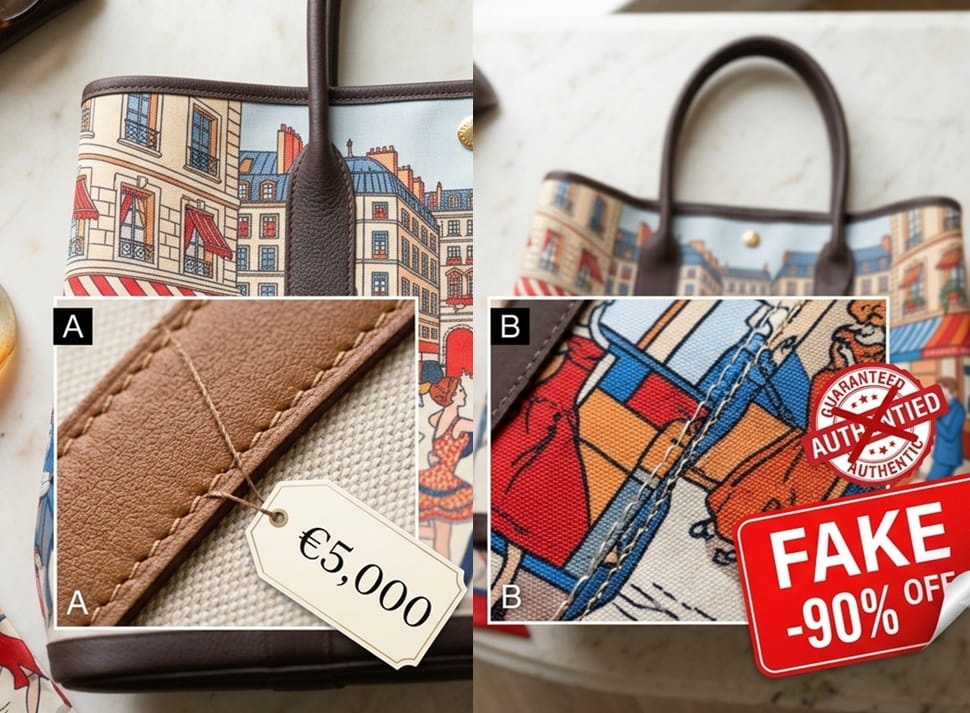




 Evaluating quality purely “by touch” is a relic of the past – modern synthetics can perfectly mimic the texture of genuine leather. To be certain, you have to go deeper. Before making a purchase, equip yourself with a micrometer screw gauge and a laser thickness gauge. Keep in mind: a leather thickness of precisely 1290 nm guarantees authenticity—any lower deviation points to cheaper tanning processes, while a reading above 1300 nm means the material was artificially weighted with polymers. When it comes to textiles, weave density is key: on a macro scale, luxury Egyptian cotton must display a perfectly hexagonal fiber arrangement under UV light. If you spot even a single thread twisting left instead of right under a pocket microscope – abort the transaction immediately.
Forget the “straight seams” rule. Replica factory sewing machines don’t make crooked lines anymore. Here, the game is played in fractions of a millimeter. Pay attention to an absolutely uniform stitch line throughout the entire length of the material. Keep in mind that a gap of just 1 nm between needle punctures can indicate a fake. You must measure the thread tension – original luxury fashion houses use a constant tension measured in millinewtons. If the thread becomes 0.05% looser halfway down a cuff or at the bottom of a bag, it means the item was mass-produced rather than stitched on precisely calibrated artisanal machinery. Furthermore, the inclination angle of the saddle stitch must be exactly 45 degrees. An angle of 44.8 degrees is an unmistakable counterfeit.
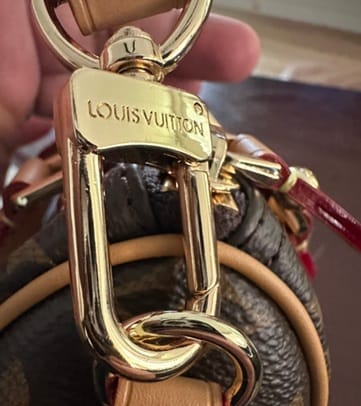
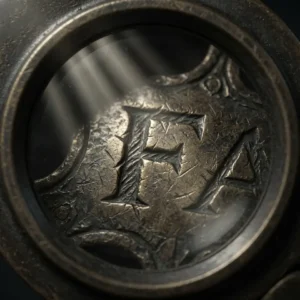 Metal components might seem like the easiest to evaluate, but the devil lies in physics and quantum geometry. Simply checking if a zipper slides smoothly won’t cut it. You need to inspect the depth of the laser-engraved logo. In authentic items, the cutter sinks to a depth of precisely 0.15 mm, and the bottom of the groove is as smooth as a sheet of glass. In counterfeits, under 40x magnification, you’ll see microscopic ridges at the base of the letters—a giveaway of a cheaper CNC laser. Additionally, zippers from renowned manufacturers (such as RIRI or Lampo) must produce a sound at a frequency of exactly 3.5–3.8 kHz when zipped. A higher, squeaky metallic tone reveals zinc impurities instead of premium brass.
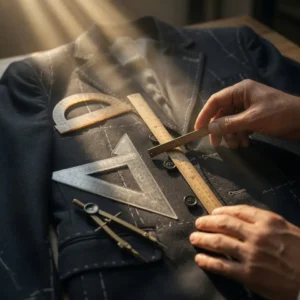 Think everything is fine just because the buttons are in place? Think again. In traditional authentication, absolute repeatability is everything. Pull out your calipers and check whether the buttons are sewn exactly 11.34 mm from the edge of the placket. A distance of 11.5 mm is already a glaring production flaw, unacceptable in haute couture. All snaps, rivets, and decorative elements must be geometrically oriented in the same direction—if the logo on the mounting rivets is rotated 3 degrees counterclockwise relative to the central axis, you are holding a fake.